
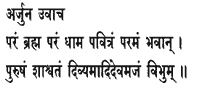
Arjuna said: Thou art the supreme Brahman, the supreme Abode, the supreme Purity, the one permanent, the divine Purusha, the original Godhead, the Unborn, the all-pervading Lord.
Sankhya, Yoga and Vedanta
Sri Aurobindo
THE WHOLE object of the first six chapters of the Gita is to synthetise in a large frame of Vedantic truth the two methods, ordinarily supposed to be diverse and even opposite, of the Sankhyas and the Yogins. The Sankhya is taken as the starting-point and the basis; but it is from the beginning and with a progressively increasing emphasis permeated with the ideas and methods of Yoga and remoulded in its spirit. The practical difference, as it seems to have presented itself to the religious minds of that day, lay first in this that Sankhya proceeded by knowledge and through the Yoga of the intelligence, while Yoga proceeded by works and the transformation of the active consciousness and, secondly,—a corollary of this first distinction,—that Sankhya led to entire passivity and the renunciation of works, sanny¯asa, while Yoga held to be quite sufficient the inner renunciation of desire, the purification of the subjective principle which leads to action and the turning of works Godwards, towards the divine existence and towards liberation. Yet both had the same aim, the transcendence of birth and of this terrestrial existence and the union of the human soul with the Highest. This at least is the difference as it is presented to us by the Gita. The difficulty which Arjuna feels in understanding any possible synthesis of these oppositions is an indication of the hard line that was driven in between these two systems in the normal ideas of the time. The Teacher sets out by reconciling works and the Yoga of the intelligence: the latter, he says, is far superior to mere works; it is by the Yoga of the Buddhi, by knowledge raising man out of the ordinary human mind and its desires into the purity and equality of the Brahmic condition free from all desire that works can be made acceptable. Yet are works a means of salvation, but works thus purified by knowledge. Filled with the notions of the then prevailing culture, misled by the emphasis which the Teacher lays upon the ideas proper to Vedantic Sankhya, conquest of the senses, withdrawal from mind into the Self, ascent into the Brahmic condition, extinction of our lower personality in the Nirvana of impersonality,—for the ideas proper to Yoga are as yet subordinated and largely held back,—Arjuna is perplexed and asks, “If thou holdest the intelligence to be greater than works, why then dost thou appoint me to a terrible work? Thou seemest to bewilder my intelligence with a confused and mingled speech; tell me then decisively that one thing by which I may attain to my soul’s weal.” In answer Krishna affirms that the Sankhya goes by knowledge and renunciation, the Yoga by works; but the real renunciation is impossible without Yoga, without works done as a sacrifice, done with equality and without desire of the fruit, with the perception that it is Nature which does the actions and not the soul; but immediately afterwards he declares that the sacrifice of knowledge is the highest, all work finds its consummation in knowledge, by the fire of knowledge all works are burnt up; therefore by Yoga works are renounced and their bondage overcome for the man who is in possession of his Self. Again Arjuna is perplexed; here are desireless works, the principle of Yoga, and renunciation of works, the principle of Sankhya, put together side by side as if part of one method, yet there is no evident reconciliation between them. For the kind of reconciliation which the Teacher has already given,—in outward inaction to see action still persisting and in apparent action to see a real inaction since the soul has renounced its illusion of the worker and given up works into the hands of the Master of sacrifice, —is for the practical mind of Arjuna too slight, too subtle and expressed almost in riddling words; he has not caught their sense or at least not penetrated into their spirit and reality. Therefore he asks again, “Thou declarest to me the renunciation of works, O Krishna, and again thou declarest to me Yoga; which one of these is the better way, that tell me with a clear decisiveness.” The answer is important, for it puts the whole distinction very clearly and indicates though it does not develop entirely the line of reconciliation. “Renunciation and Yoga of works both bring about the soul’s salvation, but of the two the Yoga of works is distinguished above the renunciation of works. He should be known as always a Sannyasin (even when he is doing action) who neither dislikes nor desires; for free from the dualities he is released easily and happily from the bondage. Children speak of Sankhya and Yoga apart from each other, not the wise; if a man applies himself integrally to one, he gets the fruit of both,” because in their integrality each contains the other. “The status which is attained by the Sankhya, to that the men of the Yoga also arrive; who sees Sankhya and Yoga as one, he sees. But renunciation is difficult to attain without Yoga; the sage who has Yoga attains soon to the Brahman; his self becomes the self of all existences (of all things that have become), and even though he does works, he is not involved in them.” He knows that the actions are not his, but Nature’s and by that very knowledge he is free; he has renounced works, does no actions, though actions are done through him; he becomes the Self, the Brahman, brahmabhu¯ ta, he sees all existences as becomings (bhu¯ ta¯ni) of that self-existent Being, his own only one of them, all their actions as only the development of cosmic Nature working through their individual nature and his own actions also as a part of the same cosmic activity. This is not the whole teaching of the Gita; for as yet there is only the idea of the immutable self or Purusha, the Akshara Brahman, and of Nature, Prakriti, as that which is responsible for the cosmos and not yet the idea, clearly expressed, of the Ishwara, the Purushottama; as yet only the synthesis of works and knowledge and not yet, in spite of certain hints, the introduction of the supreme element of devotion which becomes so important afterwards; as yet only the one inactive Purusha and the lower Prakriti and not yet the distinction of the triple Purusha and the double Prakriti. It is true the Ishwara is spoken of, but his relation to the self and nature is not yet made definite. The first six chapters only carry the synthesis so far as it can be carried without the clear expression and decisive entrance of these all-important truths which, when they come in, must necessarily enlarge and modify, though without abolishing, these first reconciliations. Twofold, says Krishna, is the self-application of the soul by which it enters into the Brahmic condition: “that of the Sankhyas by the Yoga of knowledge, that of the Yogins by the Yoga of works.” This identification of Sankhya with Jnanayoga and of Yoga with the way of works is interesting; for it shows that quite a different order of ideas prevailed at that time from those we now possess as the result of the great Vedantic development of Indian thought, subsequent evidently to the composition of the Gita, by which the other Vedic philosophies fell into desuetude as practical methods of liberation. To justify the language of the Gita we must suppose that at that time it was the Sankhya method which was very commonly1 adopted by those who followed the path of knowledge. Subsequently, with the spread of Buddhism, the Sankhya method of knowledge must have been much overshadowed by the Buddhistic. Buddhism, like the Sankhya non-Theistic and anti-Monistic, laid stress on the impermanence of the results of the cosmic energy, which it presented not as Prakriti but as Karma because the Buddhists admitted neither the Vedantic Brahman nor the inactive Soul of the Sankhyas, and it made the recognition of this impermanence by the discriminating mind its means of liberation. When the reaction against Buddhism arrived, it took up not the old Sankhya notion, but the Vedantic form popularised by Shankara who replaced the Buddhistic impermanence by the cognate Vedantic idea of illusion, Maya, and the Buddhistic idea of Non-Being, indefinable Nirvana, a negative Absolute, by the opposite and yet cognate Vedantic idea of the indefinable Being, Brahman, an ineffably positive Absolute in which all feature and action and energy cease because in That they never really existed and are mere illusions of the mind. It is the method of Shankara based upon these concepts of his philosophy, it is the renunciation of life as an illusion of which we ordinarily think when we speak
now of the Yoga of knowledge. But in the time of the Gita Maya was evidently not yet quite the master word of the Vedantic philosophy, nor had it, at least with any decisive clearness, the connotation which Shankara brought out of it with such a luminous force and distinctness; for in the Gita there is little talk of Maya and much of Prakriti and, even, the former word is used as little more than an equivalent of the latter but only in its inferior status; it is the lower Prakriti of the three gunas, traigun.yamay¯ı m¯ay¯a. Prakriti, not illusive Maya, is in the teaching of the Gita the effective cause of cosmic existence. Still, whatever the precise distinctions of their metaphysical ideas, the practical difference between the Sankhya and Yoga as developed by the Gita is the same as that which now exists between the Vedantic Yogas of knowledge and of works, and the practical results of the difference are also the same. The Sankhya proceeded like the Vedantic Yoga of knowledge by the Buddhi, by the discriminating intelligence; it arrived by reflective thought, vic ¯ara, at right discrimination, viveka, of the true nature of the soul and of the imposition on it of the works of Prakriti through attachment and identification, just as the Vedantic method arrives by the same means at the right discrimination of the true nature of the Self and of the imposition on it of cosmic appearances by mental illusion which leads to egoistic identification and attachment. In the Vedantic method Maya ceases for the soul by its return to its true and eternal status as the one Self, the Brahman, and the cosmic action disappears; in the Sankhya method the working of the gun. as falls to rest by the return of the soul to its true and eternal status as the inactive Purusha and the cosmic action ends. The Brahman of the Mayavadins is silent, immutable and inactive; so too is the Purusha of the Sankhya; therefore for both ascetic renunciation of life and works is a necessary means of liberation. But for the Yoga of the Gita, as for the Vedantic Yoga of works, action is not only a preparation but itself the means of liberation; and it is the justice of this view which the Gita seeks to bring out with such an unceasing force and insistence,—an insistence, unfortunately, which could not prevail in India against the tremendous tide of Buddhism,2 was lost afterwards in the intensity of ascetic illusionism and the fervour of world-shunning saints and devotees and is only now beginning to exercise its real and salutary influence on the Indian mind. Renunciation is indispensable, but the true renunciation is the inner rejection of desire and egoism; without that the outer physical abandoning of works is a thing unreal and ineffective, with it it ceases even to be necessary, although it is not forbidden. Knowledge is essential, there is no higher force for liberation, but works with knowledge are also needed; by the union of knowledge and works the soul dwells entirely in the Brahmic status not only in repose and inactive calm, but in the very midst and stress and violence of action. Devotion is all-important, but works with devotion are also important; by the union of knowledge, devotion and works the soul is taken up into the highest status of the Ishwara to dwell there in the Purushottama who is master at once of the eternal spiritual calm and the eternal cosmic activity. This is the synthesis of the Gita. But, apart from the distinction between the Sankhya way of knowledge and the Yoga way of works, there was another and similar opposition in the Vedanta itself, and this also the Gita has to deal with, to correct and to fuse into its large restatement of the Aryan spiritual culture. This was the distinction between Karmakanda and Jnanakanda, between the original thought that led to the philosophy of the Purva Mimansa, the Vedavada, and that which led to the philosophy of the Uttara Mimansa,3 the Brahmavada, between those who dwelt in the tradition of the Vedic hymns and the Vedic sacrifice and those who put these aside as a lower knowledge and laid stress on the lofty metaphysical knowledge which emerges from the Upanishads.
For the pragmatic mind of the Vedavadins the Aryan religion of the Rishis meant the strict performance of the Vedic sacrifices and the use of the sacred Vedic mantras in order to possess all human desires in this world, wealth, progeny, victory, every kind of good fortune, and the joys of immortality in Paradise beyond. For the idealism of the Brahmavadins thiswas only a preliminary preparation and the real object of man, true purus. ¯artha, began with his turning to the knowledge of the Brahman which would give him the true immortality of an ineffable spiritual bliss far beyond the lower joys of this world or of any inferior heaven. Whatever may have been the true and original sense of the Veda, this was the distinction which had long established itself and with which therefore the Gita has to deal. Almost the first word of the synthesis of works and knowledge is a strong, almost a violent censure and repudiation of the Vedavada, “this flowery word which they declare who have not clear discernment, devoted to the creed of the Veda, whose creed is that there is nothing else, souls of desire, seekers of Paradise, —it gives the fruits of the works of birth, it is multifarious with specialities of rites, it is directed to enjoyment and lordship as its goal.” The Gita even seems to go on to attack the Veda itself which, though it has been practically cast aside, is still to Indian sentiment intangible, inviolable, the sacred origin and authority for all its philosophy and religion. “The action of the three gunas is the subject matter of the Veda; but do thou become free from the triple guna, O Arjuna.” The Vedas in the widest terms, “all the Vedas”,—which mightwell include the Upanishads also and seems to include them, for the general term S´ruti is used later on,—are declared to be unnecessary for the man who knows. “As much use as there is in a well with water in flood on every side, so much is there in all the Vedas for the Brahmin who has the knowledge.” Nay, the Scriptures are even a stumbling-block; for the letter of the Word—perhaps because of its conflict of texts and its various and mutually dissentient interpretations— bewilders the understanding, which can only find certainty and concentration by the light within. “When thy intelligence shall cross beyond the whorl of delusion, then shalt thou become indifferent to Scripture heard or that which thou hast yet to hear, ganta¯ si nirvedam˙ s´rotavyasya s´rutasya ca. When thy intelligence which is bewildered by the Sruti, ´srutivipratipann ¯a, shall stand unmoving and stable in Samadhi, then shalt thou attain to Yoga.” So offensive is all this to conventional religious sentiment that attempts are naturally made by the convenient and indispensable human faculty of text-twisting to put a different sense on some of these verses, but themeaning is plain and hangs together from beginning to end. It is confirmed and emphasised by a subsequent passage in which the knowledge of the knower is described as passing beyond the range of Veda and Upanishad, ´sabdabrahm¯ ativartate. Let us see, however, what all this means; for we may be sure that a synthetic and catholic system like the Gita’s will not treat such important parts of the Aryan culture in a spirit of mere negation and repudiation. The Gita has to synthetise the Yoga doctrine of liberation by works and the Sankhya doctrine of liberation by knowledge; it has to fuse karma with jn˜ a¯na. It has at the same time to synthetise the Purusha and Prakriti idea common to Sankhya and Yoga with the Brahmavada of the current Vedanta in which the Purusha, Deva, Ishwara,—supreme Soul, God, Lord,—of the Upanishads all became merged in the one all-swallowing concept of the immutable Brahman; and it has to bring out again from its overshadowing by that concept but not with any denial of it the Yoga idea of the Lord or Ishwara. It has too its own luminous thought to add, the crown of its synthetic system, the doctrine of the Purushottama and of the triple Purusha for which, though the idea is there, no precise and indisputable authority can be easily found in the Upanishads and which seems indeed at first sight to be in contradiction with that text of the Sruti where only two Purushas are recognised. Moreover, in synthetising works and knowledge it has to take account not only of the opposition of Yoga and Sankhya, but of the opposition of works to knowledge in Vedanta itself, where the connotation of the two words and therefore their point of conflict is not quite the same as the point of the Sankhya-Yoga opposition. It is not surprising at all, one may observe in passing, that with the conflict of so many philosophical schools all founding themselves on the texts of the Veda and Upanishads, the Gita should describe the understanding as being perplexed and confused, led in different directions by the Sruti, ´srutivipratipann ¯a. What battles are even now delivered by Indian pundits and metaphysicians over the meaning of the ancient texts and to what different conclusions they lead! The understanding may well get disgusted and indifferent, gant¯ asi nirvedam, refuse to hear any more texts new or old, ´srotavyasya ´srutasya ca, and go into itself to discover the truth in the light of a deeper and inner and direct experience. In the first six chapters the Gita lays a large foundation for its synthesis of works and knowledge, its synthesis of Sankhya, Yoga and Vedanta. But first it finds that karma, works, has a particular sense in the language of the Vedantins; it means the Vedic sacrifices and ceremonies or at most that and the ordering of life according to the Grihyasutras in which these rites are the most important part, the religious kernel of the life. By works the Vedantins understood these religious works, the sacrificial system, the yajn˜ a, full of a careful order, vidhi, of exact and complicated rites, kriy ¯ a-vi´ses.a-bahul¯am. But in Yoga works had a much wider significance. The Gita insists on this wider significance; in our conception of spiritual activity all works have to be included, sarva-karm¯an. i. At the same time it does not, like Buddhism, reject the idea of the sacrifice, it prefers to uplift and enlarge it. Yes, it says in effect, not only is sacrifice, yajn˜ a, the most important part of life, but all life, all works should be regarded as sacrifice, are yajn˜ a, though by the ignorant they are performed without the higher knowledge and by the most ignorant not in the true order, avidhi-pu¯rvakam. Sacrifice is the very condition of life; with sacrifice as their eternal companion the Father of creatures created the peoples. But the sacrifices of the Vedavadins are offerings of desire directed towards material rewards, desire eager for the result of works, desire looking to a larger enjoyment in Paradise as immortality and highest salvation. This the system of the Gita cannot admit; for that in its very inception starts with the renunciation of desire, with its rejection and destruction as the enemy of the soul. The Gita does not deny the validity even of the Vedic sacrificial works; it admits them, it admits that by these means one may get enjoyment here and Paradise beyond; it is I myself, says the divine Teacher, who accept these sacrifices and to whom they are offered, I who give these fruits in the form of the gods since so men choose to approach me. But this is not the true road, nor is the enjoyment of Paradise the liberation and fulfilment which man has to seek. It is the ignorant who worship the gods, not knowing whom they are worshipping ignorantly in these divine forms; for they are worshipping, though in ignorance, the One, the Lord, the only Deva, and it is he who accepts their offering. To that Lord must the sacrifice be offered, the true sacrifice of all the life’s energies and activities, with devotion, without desire, for His sake and for the welfare of the peoples. It is because the Vedavada obscures this truth and with its tangle of ritual ties man down to the action of the three gunas that it has to be so severely censured and put roughly aside; but its central idea is not destroyed; transfigured and uplifted, it is turned into a most important part of the true spiritual experience and of the method of liberation. The Vedantic idea of knowledge does not present the same difficulties. The Gita takes it over at once and completely and throughout the six chapters quietly substitutes the still immutable Brahman of the Vedantins, the One without a second immanent in all cosmos, for the still immutable but multiple Purusha of the Sankhyas. It accepts throughout these chapters knowledge and realisation of the Brahman as the most important, the indispensable means of liberation, even while it insists on desireless works as an essential part of knowledge. It accepts equally Nirvana of the ego in the infinite equality of the immutable, impersonal Brahman as essential to liberation; it practically identifies this extinction with the Sankhya return of the inactive immutable Purusha upon itself when it emerges out of identification with the actions of Prakriti; it combines and fuses the language of the Vedanta with the language of the Sankhya, as had already indeed been done by certain of the Upanishads.4 But still there is a defect in the Vedantic position which has to be overcome. We may, perhaps, conjecture that at this time the Vedanta had not yet redeveloped the later theistic tendencies which in the Upanishads are already present as an element, but not so prominent as in the Vaishnava philosophies of the later Vedantins where they become indeed not only prominent but paramount. We may take it that the orthodox Vedanta was, at any rate in its main tendencies, pantheistic at the basis, monistic at the summit.5 It knew of the Brahman, one without a second; it knew of the Gods, Vishnu, Shiva, Brahma and the rest, who all resolve themselves into the Brahman; but the one supreme Brahman as the one Ishwara, Purusha, Deva— words often applied to it in the Upanishads and justifying to that extent, yet passing beyond the Sankhya and the theistic conceptions— was an idea that had fallen from its pride of place;6 the names could only be applied in a strictly logical Brahmavada to subordinate or inferior phases of the Brahman-idea. The Gita proposes not only to restore the original equality of these names and therefore of the conceptions they indicate, but to go a step farther. The Brahman in its supreme and not in any lower aspect has to be presented as the Purusha with the lower Prakriti for its Maya, so to synthetise thoroughly Vedanta and Sankhya, and as Ishwara, so to synthetise thoroughly both with Yoga; but the Gita is going to represent the Ishwara, the Purushottama, as higher even than the still and immutable Brahman, and the loss of ego in the impersonal comes in at the beginning as only a great initial and necessary step towards union with the Purushottama. For the Purushottama is the supreme Brahman. It therefore passes boldly beyond the Veda and the Upanishads as they were taught by their best authorised exponents and affirms a teaching of its own which it has developed from them,
but which may not be capable of being fitted in within the four corners of their meaning as ordinarily interpreted by the Vedantins.7 In fact without this free and synthetic dealing with the letter of the Scripture a work of large synthesis in the then state of conflict between numerous schools and with the current methods of Vedic exegesis would have been impossible. The Gita in later chapters speaks highly of the Veda and the Upanishads. They are divine Scriptures, they are the Word. The Lord himself is the knower of Veda and the author of Vedanta, vedavid ved¯antakr.t; the Lord is the one object of knowledge in all the Vedas, sarvair vedair aham eva vedyah. , a language which implies that the word Veda means the book of knowledge and that these Scriptures deserve their appellation. The Purushottama from his high supremacy above the Immutable and the mutable has extended himself in the world and in the Veda. Still the letter of the Scripture binds and confuses, as the apostle of Christianity warned his disciples when he said that the letter killeth and it is the spirit that saves; and there is a point beyond which the utility of the Scripture itself ceases. The real source of knowledge is the Lord in the heart; “I am seated in the heart of every man and from me is knowledge,” says the Gita; the Scripture is only a verbal form of that inner Veda, of that self-luminous Reality, it is ´sabdabrahma: the mantra, says the Veda, has risen from the heart, from the secret place where is the seat of the truth, sadan¯adr. tasya, guh¯ay¯am. That origin is its sanction; but still the infinite Truth is greater than its word. Nor shall you say of any Scripture that it alone is all-sufficient and no other truth can be admitted, as the Vedavadins said of the Veda, n¯anyad ast¯ıti v¯adinah. . This is a saving and liberating word which must be applied to all the Scriptures of the world. Take all the Scriptures that are or have been, Bible and Koran
and the books of the Chinese, Veda and Upanishads and Purana and Tantra and Shastra and the Gita itself and the sayings of thinkers and sages, prophets and Avatars, still you shall not say that there is nothing else or that the truth your intellect cannot find there is not true because you cannot find it there. That is the limited thought of the sectarian or the composite thought of the eclectic religionist, not the untrammelled truth-seeking of the free and illumined mind and God-experienced soul. Heard or unheard before, that always is the truth which is seen by the heart of man in its illumined depths or heard within from the Master of all knowledge, the knower of the eternal Veda.
Sri Aurobindo
 About Us | ©1999 - 2009 searchforlight.org
All extracts and quotations from the written works of Sri Aurobindo and the Mother and the Photographs of
the Mother and Sri Aurobindo are copyright Sri Aurobindo Ashram Trust, Pondicherry -605002 India.